How to create a CE manual in five steps
22/05/2026
For most manufacturers, the CE manual is the most important legal defence they own. And yet it is usually written last, by the engineer with the least time. The gap between what a CE manual should be and how it actually comes into existence is precisely where problems start: in audits, in Notified Body reviews, and in liability claims.
Below I set out, in five steps, how to build a CE manual that does not only pass an audit but also holds up when it really matters.
Table of contents
- What is a CE manual?
- What goes into a CE manual?
- How to create a CE manual: five steps
- Does a CE manual need to be translated?
- Can a CE manual be delivered digitally?
- Does a CE manual cover the UK and the US?
- What are the risks without a CE manual?
- Short case: Van Delft Pepernoten
- Frequently asked questions
What is a CE manual?
A CE manual is the instructions for use that accompany a product covered by CE marking. It is not a marketing piece, not an optional extra, and not a tail-end deliverable of the design process. It sits in the conformity evidence, alongside the rest of the technical file, and demonstrates that the product complies with applicable EU legislation.
What goes into a CE manual?
The content is shaped by three layers, always worked through in this order:
- The applicable EU directive or regulation
- The harmonised vertical and horizontal standards
- The output of the risk assessment
The role of the risk assessment
ISO 12100 prescribes a three-step method: eliminate risks first by design, then by safeguarding, and only as a third option through information for the user. What remains as residual risk after steps one and two becomes warnings and safety instructions in the manual. The manual is therefore not a safety net for an unsafe design. Whoever skips the risk assessment and bolts on warnings afterwards writes instructions that are legally disconnected from the actual risks. That is the definition of a manual that is formally correct and materially weak.
How to create a CE manual: five steps
Step 1: Identify the relevant directives and regulations
Always start by identifying which EU legislation applies to your product. A bench drill falls under the Machinery Directive or Machinery Regulation. An electric kettle under the Low Voltage Directive, the EMC Directive, and the RoHS Directive. An EV charger possibly under the Radio Equipment Directive plus the Low Voltage Directive. Many products fall under several frameworks at once, and each directive sets its own requirements for the content and the clarity of the instructions.
For more on identifying the directives that apply to your product, see this article.
The Machinery Regulation 2023/1230 explicitly requires "clear, comprehensible" instructions. The content requirements the Machinery Regulation places on the instructions for use can be found in section 1.7.4.2.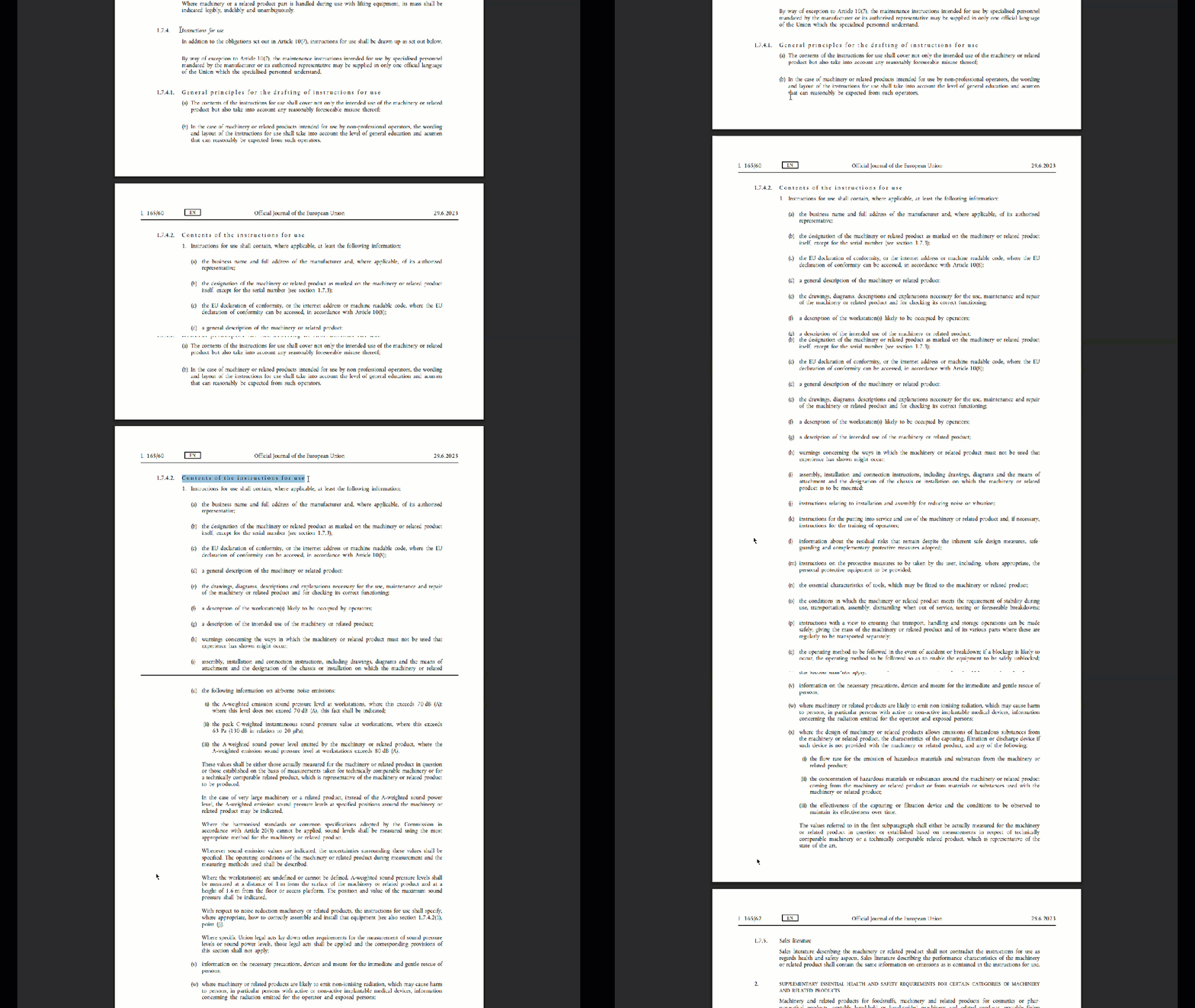 The Machinery Regulation 2023/1230 specifies in section 1.7.4.2 what an instruction for use must contain at minimum.
That sounds obvious, but in practice manuals are still written by engineers who know the product so well that they skip exactly the steps that are not obvious to the end user. For Morssinkhof Plastics we closed that gap by formally translating the content requirements from the relevant directives into a structured information model, before a single sentence was written. Machinery Regulation 2023/1230 explicitly prescribes "clear and understandable" instructions.
Step 2: Identify the applicable standards
Directives set objectives, standards set means. By correctly applying a harmonised standard you create the presumption of conformity with the directive. For instructions for use you work with three types of standards that complement each other:
- Vertical or product-specific standards (Type C), for example EN 1493:2022 for vehicle lifts, EN 60335-2-15 for electric appliances for heating liquids, or EN IEC 61851-1:2019 for charging stations for electric vehicles.
- Horizontal standards, the most important being EN IEC/IEEE 82079-1:2019, the international standard for the preparation of instructions for use, covering everything from a tin of paint to a complete plant.
- EN ISO 20607:2019, the machinery-specific instruction handbook standard that bridges ISO 12100 and EN IEC/IEEE 82079-1, harmonised under the Machinery Regulation.
How do you find the right set of standards for your product? Three steps:
- Start with the harmonised standards for your product group. On the European Commission website, each directive has a "Summary list of titles and references of harmonised standards" PDF. Search it by product or application term. Note the standard numbers, open each in preview on a national standardisation institute site such as evs.ee, and check in the scope and the table of contents whether there is a section on instructions for use. Many titles suggest relevance that the scope then excludes.
- Look beyond the harmonised list. Not every relevant standard is on it. Search the same standardisation institute with multiple terms around your product and check each result for instruction-for-use requirements.
- Verify which standards your competitors list in their Declarations of Conformity. Not as a copy source, but as a sanity check. A competitor's choice is no proof of correctness, but it is a signal of what you might have missed.
For the extended how-to, see this article.
In my experience, this is the step where manufacturers can least defend their choice. For Nunc we mapped the standards set systematically rather than relying on the standard most familiar to the engineering team. The difference is not in which standard you apply, it is in whether you can explain why.
Step 3: Translate the requirements into concrete content
For each directive and standard, extract the content and form requirements. EN IEC/IEEE 82079-1 covers product identification, intended use, reasonably foreseeable misuse, installation, safety, operation, maintenance, and disposal, plus formal requirements for readability, terminology, and illustrations. Example of a requirement from EN IEC/IEEE 82079-1.
EN ISO 20607 supplements this for machinery with topics such as transport, installation, commissioning, training, and decommissioning. For Van der Waay we have been producing manuals for over ten years that satisfy both EN IEC/IEEE 82079-1 and EN ISO 20607. Example of a requirement from EN ISO 20607.
Product-specific standards add the detail. For water heaters and deep fryers, EN 60335-2-15 specifies content requirements for instructions on thermostatic failure, dry-run protection, and specific warnings. For charging stations, EN IEC 61851-1:2019 sets requirements for describing charging modes, protection functions, and operating conditions, as we worked out in the We Drive Solar case study. Example of a requirement from EN 60335-2-15.
 Example of a requirement from EN IEC 61851-1:2019.
Step 4: Assemble the manual
Only here does the writing begin, and this is where the path forks between manuals that get past a Notified Body and those that come back. Four workstreams run in parallel: technical writing, illustrations, proofread, and translation.
Technical writing in line with EN IEC/IEEE 82079-1 means active verbs, one instruction per step, consistent terminology, and task-oriented sections. Operators on a production line do not read flowing prose. They look up a specific action, perform it, and move on. A manual that does not support that behaviour will cost you operational time later, and ultimately customers.
Step 5: Add the safety instructions
The warnings produced by the risk assessment go into the manual using a recognisable signal-word system (DANGER, WARNING, CAUTION per ISO 3864-2 or, for the US market, ANSI Z535.6). Place them where the user actually meets the risk, not only in a generic safety chapter that gets skipped. A warning in the right place is evidence of due care; a warning in the wrong place is a formality.
Does a CE manual need to be translated?
Yes. Decision No 768/2008/EC requires that instructions are written in a language the end user can easily understand, as determined by the Member State where the product is placed on the market. Every CE directive carries this requirement forward. EN IEC/IEEE 82079-1 also prescribes that instructions are translated into the official language or languages of the country where the product is sold, and adds quality criteria for source terminology and translation work. Building translation into your process from the start is cheaper than translation as a closing phase: correcting source terminology in fifteen languages at once is a cost you do not want to repeat. Instructions must be translated into the official language or languages of the country where the product is sold in accordance with EN IEC/IEEE 82079-1.
Can a CE manual be delivered digitally?
The Machinery Regulation 2023/1230 allows digital delivery, provided the user can download, save, and print the instructions, and provided they remain available even when the machine itself fails. Safety information often still has to ship in print, and a printed version must be supplied within a reasonable time on request. INSTRKTIV's position here is consistent: digital is permitted only when your risk assessment establishes that digital delivery does not lead to risks that would need to be mitigated by a printed form. The cost saving of digital is real, but it must not steer the risk assessment. For consumer products the bar sits higher than for business-to-business.
Does a CE manual cover the UK and the US?
For the UK: yes, in nearly all product categories. In August 2023 the UK government extended recognition of CE marking for the GB market indefinitely. UKCA marking is optional in most cases and not required for market access.
For the US: no. The US framework is built around ANSI and UL standards. For warnings you apply ANSI Z535.6, which uses different colours, signal words, and layout rules than ISO 3864.
What are the risks without a CE manual?
The product cannot be placed on the EU market without an adequate CE manual. Authorities can withdraw it, customs can hold or destroy it, and in the event of an incident your product liability under the revised Product Liability Directive grows significantly: incomplete or unclear instructions can themselves constitute a product defect. For e-commerce, listings can be taken offline, and a Notified Body will not approve a file in which the instructions for use fall short.
Short case: Van Delft Pepernoten
For Van Delft Pepernoten we produced the CE manual for production-line equipment. The difference between an ad-hoc instruction from the engineer and a 20607- and 82079-compliant manual is that the first one is probably correct, but it does not help and it is not compliant. The manual is not written to be read front to back. It is written to be consulted at the moment of use. Task-oriented sections, consistent terminology, and visual cues are the difference between a document that survives the audit and a document that supports the operator at the right moment.
Frequently asked questions
Do I need a CE manual for a production line?
Yes. A production line is an assembly of machinery and falls under the Machinery Regulation 2023/1230. You typically need one integrated manual plus separate sub-manuals for each constituent machine.
Do I need a CE manual for a building?
The building itself sits outside the product directives, but the equipment inside (lift, HVAC, fire detection) does fall under them. Each of those installations comes with its own CE manual.
What if my product is outside CE but covered by the GPSR?
You remain obliged to provide clear safety instructions with the product in the languages of the market. The General Product Safety Regulation 2023/988 shifts the requirements, it does not remove them.
How long must I keep the technical file including the CE manual?
Ten years after the last unit of the model is manufactured, as required by the Machinery Regulation 2023/1230. Other directives may set different retention periods.
Who can help create one?
A specialised technical writer knows the directives, the standards, and the full delivery process. The difference is measurable in time, quality, and legal exposure.
Most manuals survive audits. They do not survive claims.
A good CE manual costs more up front and saves on every other side: in audits, in claims, in operational time.